"The network economy emerging from electronic commerce"
- <Panelists>
- Mr.Hiroshi Fukuno,
- Chairman&Representative Director,Dell Computer K.K.
- Mr.Takatoshi Matsumoto,
- Chairman,Nihon Cisco Systems K.K.
- Mr.Shigemichi Matsuka,
- Senior Executive Managing Director,Hitachi,Ltd.
- Mr.Stratton Sclavos,
- President&CEO,VeriSing,Inc.
- Mr.Masakatsu Mori,
- Country Managing Partner,Andersen Consulting
- (Moderator)Waichi Sekiguchi,
- Senior Staff Writer,Nihon Keizai Shimbun,Inc.(NIKKEI)
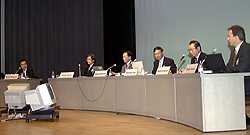 Panelists at the second discussion session of the Global Information Summit 1999 agreed that one of the major stumbling blocks in getting electronic commerce in Japan off the ground is the nation's traditional business structure.
The fear that electronic commerce, which digitally links the vendor directly to the consumer, will lead to widespread layoffs and invite the wrath of those who work as dealers and subcontractors, is immobilizing, they said.
"I say, 'Managers, be brave,'" said Masakatsu Mori, country managing partner of Andersen Consulting.
"The problem really lies with all of us here. We have been unable to alter the existing business structure," said Mori, one of the five panelists participating in the Nihon Keizai Shimbun Inc.-sponsored discussion.
Titled "The Network Economy Emerging from Electronic Commerce," the panel discussion quickly became a fault-finding mission: why Japan has been so slow in embracing the new and fast technology known as e-commerce.
In the U.S., where e-commerce, an Internet-based vehicle, has rapidly taken root, subscribers are trading stocks and doing their Christmas shopping in growing numbers.
E-commerce based activities, such as online trading or shopping, are still in the minority, but they are expected to quickly proliferate as generations of computer-literate children mature.
One of this decade's success stories is a virtual company that is continuing to grow. Amazon. com Inc., which started out as an Internet book retailer, announced a few weeks ago that it was adding pharmaceuticals to its list of online merchandise.
Reflecting on the growth of e-commerce in the U.S., panelists lamented Japan's considerable lag.
"Even if we wanted to start a company like Amazon. com, for example, there's the problem with the book wholesalers. It's for the same reason that ventures don't come out of Japan," said Takatoshi Matsumoto, vice president of Cisco Systems, Inc.
Hiroshi Fukino, chairman and representative director of Dell Computer K.K., agreed. "Electronic commerce raises the problem of employment," he said. "It becomes a social issue."
By linking the vendor directly to the consumer, e-commerce effectively cuts out the middleman -- a phenomenon that threatens the heart of Japan's long-standing economic structure.
"If Hitachi decided to sell, say, only its television sets online, we'll probably get a long line of angry dealers right outside the head office," said Shigemichi Matsuka, senior executive managing director of Hitachi, Ltd.
Matsuka also said ego probably plays a big role in Japanese corporations' reluctance to move more quickly on e-commerce. The bigger the corporation, the more protective they become of old business protocols that have made them successful in the first place, he said.
"I think the solution is to create a new company," Matsuka said.
Matsumoto agreed that e-commerce may have to rely on companies yet to emerge to thrive in Japan. "If you look at which age group uses the Internet, it's mostly people in their 20s and 30s," he said. "They are the ones who have to set up businesses that readily incorporate e-commerce."
The Japanese government didn't escape blame, either. Panelists said the government has been painstakingly slow at setting up regulations and policies that govern Internet-based commerce.
But Stratton Sclavos, President and CEO of VeriSign, Inc., a company that specializes in digital certification, offered a bit of practical advice.
Instead of seeking big changes, start with the easy things first, he said. "Start by looking at the simple supply-chain management," Sclavos said.
|


