"The network economy and information infrastructure"
- <Panelists>
- Dr.Keiji Tachikawa,
- President&CEO,NTT Mobile Communications Network,Inc.
- Mr.William L.Schrader,
- Chairman&CEO,PSINet Inc.
- Mr.Lee A.Daniels,
- President&CEO,TITUS Communications Corporation
- Mr.Hidemaru Sato,
- President,AOL Japan,Inc.
- (Moderator)Ichiya Nakamura,
- Visiting Professor,MIT Media Laboratory
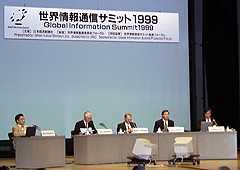 How should Japan build up its information infrastructure? That was one of the questions posed to a four-man panel in the first discussion session of the Global Information Summit 1999, and the responses showed just how split opinion still is.
On one side, free-market advocates accused Nippon Telegraph and Telephone Corp. (NTT) of holding Japan back in the race to build up infrastructure through its monopolistic powers. "NTT is probably the strongest telephone company on earth," said William Schrader, chairman and chief executive officer of PSINet Inc., a U.S.-based Internet provider. "The government and the company must be very careful to take advantage of the situation and not close doors to competitors."
Lee Daniels, president and chief executive officer of TITUS Communication Corp., a cable-television, Internet and telephone-service provider in Japan, said that the task of building up information infrastructure exposes "significant differences culturally between the U.S. and Japan."
He pointed to steady investment in the U.S. on computers for young students. "Japan is lagging far behind the U.S. and this will have a spill-over effect," he predicted.
Keiji Tachikawa, president and chief executive officer of NTT Mobile Communications Network Inc. (NTT DoCoMo), attacked the free-market advocates for presenting issues in simplistic forms. He pointed out that use of mobile telephones in Japan surpasses that of the U.S. "I disagree with simple comparisons of the U.S. and Japan. Usage will of course be different from country to country."
Ichiya Nakamura, a visiting professor at MIT Media Laboratory of the U.S., started the discussion by asking whether Japan was really lagging behind the U.S. or whether Japan should take a different road. He noted for example, that one can commonly see high-school students sending e-mail to each other by their cell phones in Japan, but hardly any high school student does this in the U.S.
But Schrader, Daniels and Hidemaru Sato, president of AOL Japan Inc., argued for more choice in the Japanese marketplace. To comments from Tachikawa that a flat-rate pricing system for telephone use is not fair because those who use the service most should pay more, Sato replied, "I think it is more fair for our customers to have a choice."
Currently, there is no flat-rate pricing system for telephone services in Japan. In the U.S., flat-rate pricing, where the telephone user pays a flat fee for usage in a certain area, is common.
Schrader was especially pointed in his attacks on NTT. He said the fact that NTT was debating the virtues of flat-rate pricing and whether or not it should be introduced in Japan is the sort of thing "that comes from a government-monopoly thinking process."
"Just allow competition to come in. We will introduce flat rate," Schrader said to Tachikawa.
Daniels stressed that competition breeds innovation. He mentioned long-distance telephone calls as an example. Two years ago, a call to the U.S. was about 120 yen a minute, he said, and now it is about 30 yen. The reason is that all sorts of call-back operations sprang up, forcing the larger, more established carriers to offer cheaper services.
|


